Meet Geelong and The Bellarine: Built around the event planner’s brief
The convention bureau site for Geelong and The Bellarine on the Business Events Edition: guided supplier search, capacity-ready venue profiles and a qualifying enquiry.
Visit meetgeelong.com.au (opens in a new tab)- Client
- Tourism Greater Geelong & The Bellarine
- Region
- Victoria
- Launched
- 2025
- Edition
- Business Events Edition
The challenge
A convention bureau connects the people who decide where an event lands with the venues and suppliers who can host it. Meet Geelong and The Bellarine is the bureau for Tourism Greater Geelong & The Bellarine, and its event planning support (bid documents, famils, site inspections, delegate boosting and more) is free, with Business Event Support Funding open to eligible events. The site had to carry that whole pipeline, from the first look at the region to a qualified enquiry landing on the bureau’s desk.
The Visitor here is not a holidaymaker. The bureau names its audience plainly: event planners, executive assistants and personal assistants, each working to a brief, a budget and a deadline. That person scopes a destination in minutes, shortlists by capacity and location, and needs to reach a venue without friction. The directory has to answer “what can it hold, and where” before the enquiry is written.
The region also had a case to make. Geelong, the site says, is Victoria’s largest regional city and Australia’s only UNESCO City of Design, an hour from Melbourne on Wadawurrung Country, with the Nyaal Banyul Geelong Convention and Event Centre on the waterfront and the Bellarine’s wineries, beaches and distilleries half an hour further on. The site needed to show, with venues and figures instead of adjectives, that this is a destination for conferences at scale as well as a place for a two-day incentive.
And there was a second edition to design, under a new name. The same organisation already ran its leisure site, Visit Geelong & The Bellarine, on Roam. The bureau, formerly Business Events Geelong and then Meet Geelong, was relaunching as Meet Geelong and The Bellarine, and needed a site for a different reader, in a different register, on the same engine.
What we built
Design approach
Meet Geelong is the second Roam edition for one client, so the two sites share infrastructure and a design language while speaking to different people. The leisure site invites and the bureau site answers the planner’s questions. Its primary navigation runs destination first, then the supplier search, then planning and resources: Our Destination, Suppliers, Plan, Resources, About and Deals.
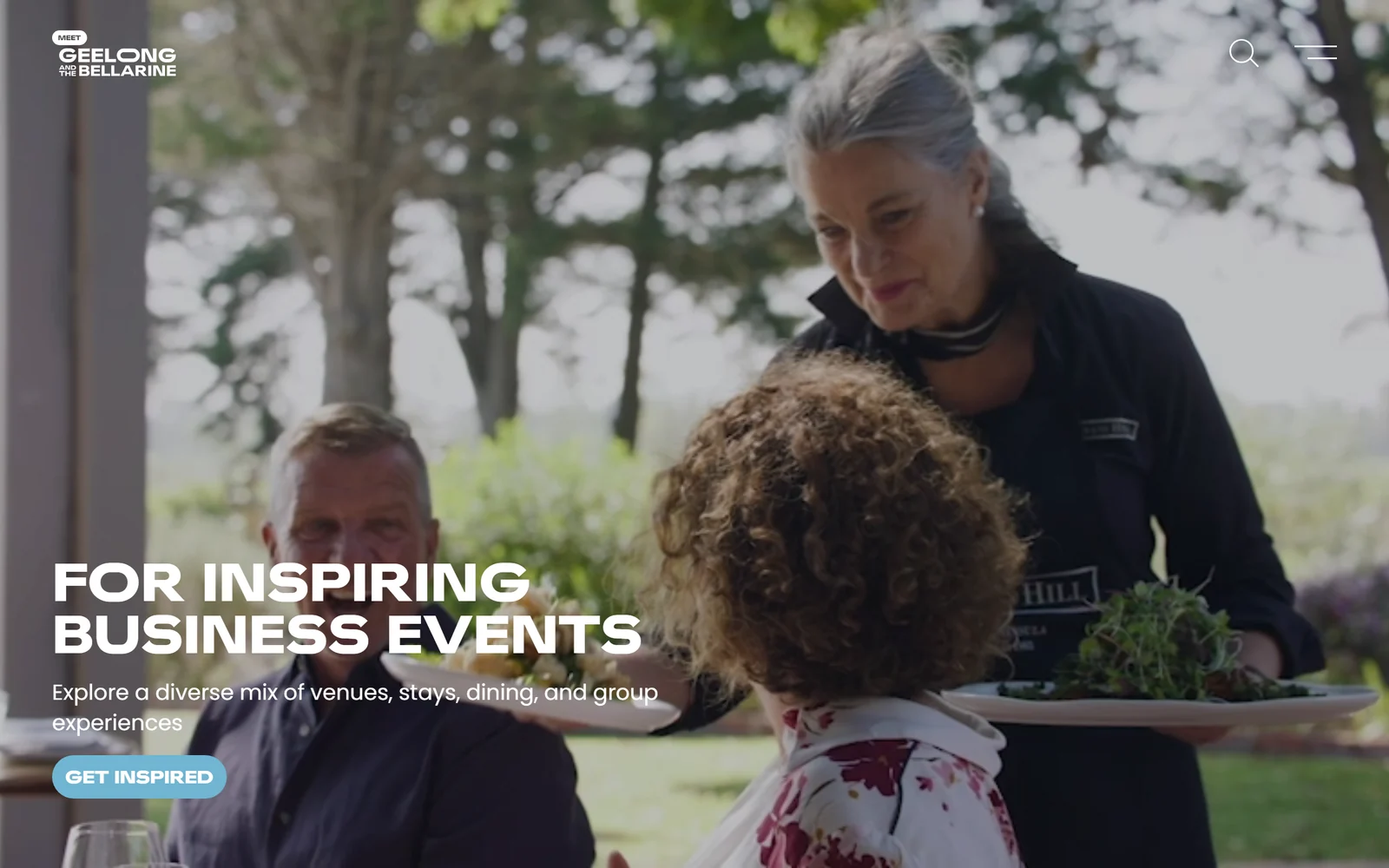
The home page opens on the bureau’s own line, “For inspiring business events”, then offers three doors (Geelong; the Bellarine; and Moorabool Valley, Werribee and the You Yangs), each carrying its drive time and distance, Geelong and Moorabool from Melbourne and the Bellarine from Geelong. Photography does the destination work. An Accessibility page points delegates to the City of Geelong Accessibility Map.

Platform features
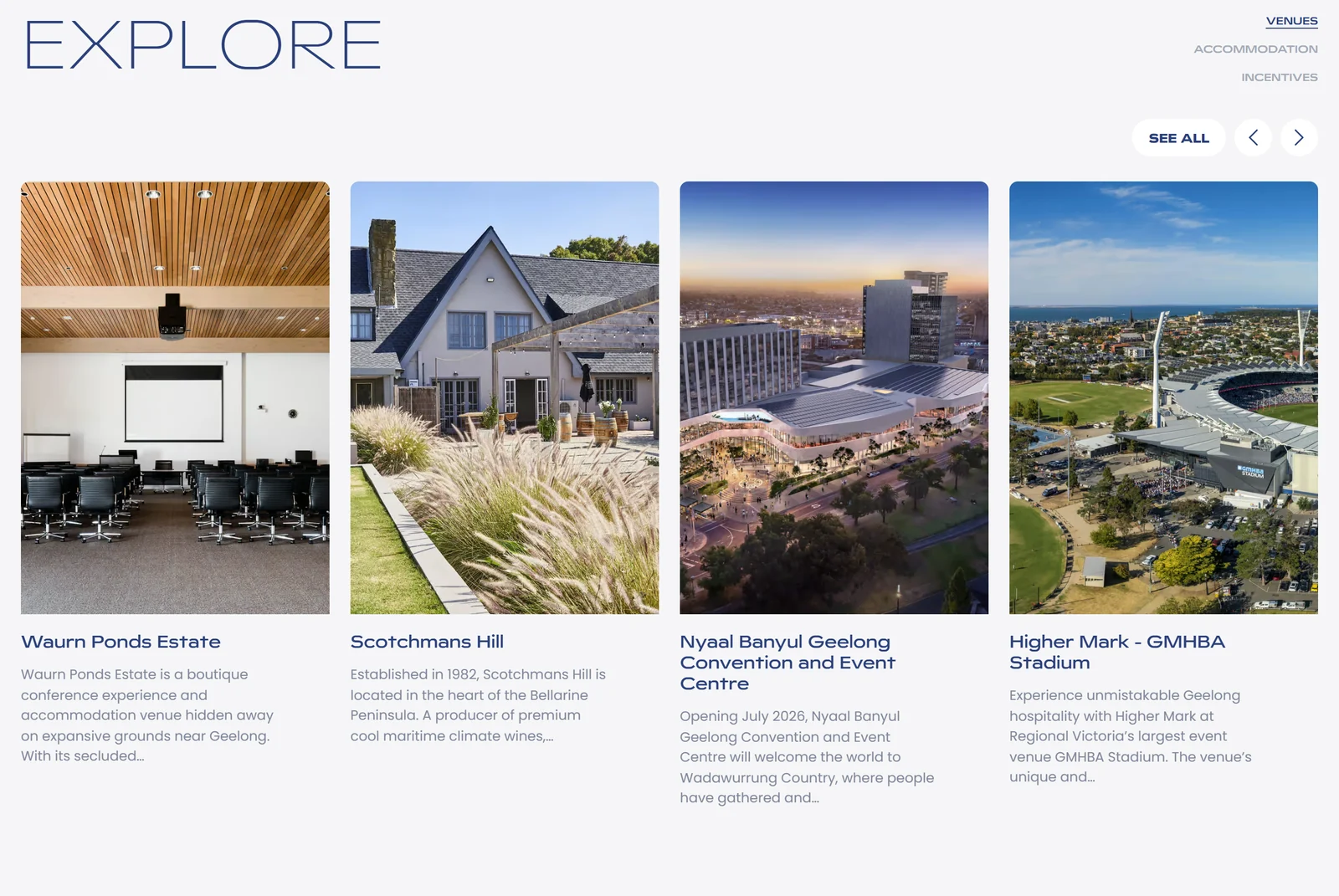
The supplier directory is the spine of the site, built on Roam’s Business Events Edition and its instant search. The Suppliers page opens with a guided search that reads as a sentence (help me find a kind of content, for a number of delegates, in a location, including a keyword) and returns results from more than 100 supplier Products: venues, accommodation, dining, incentive experiences, transport and event services.
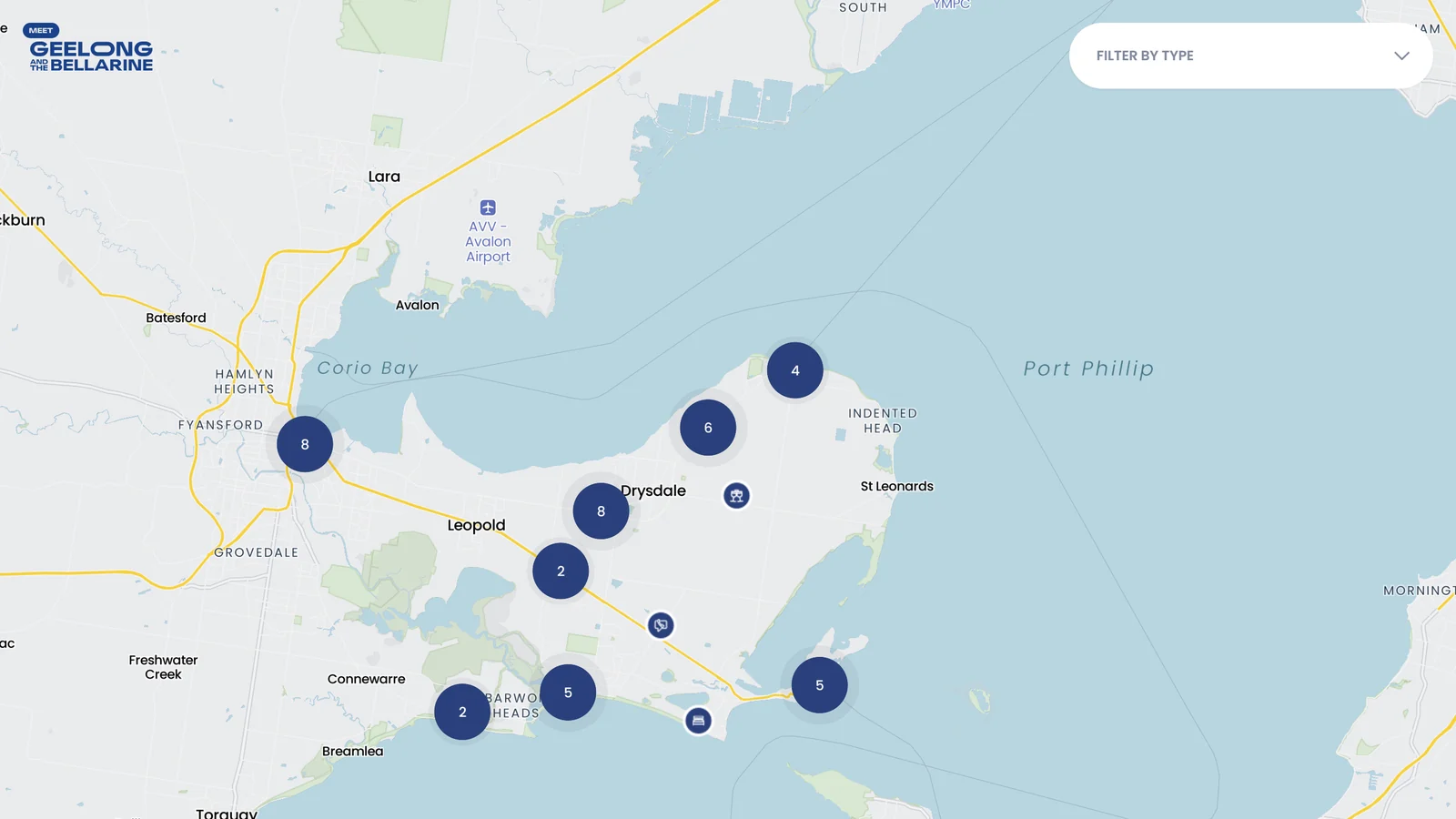
Venue and accommodation Product profiles are built for the brief. Category tags sit at the top, then the figures an organiser scans first: rooms, cocktail capacity, number of spaces. Below that, a capacity table sets out each room by layout (theatre, boardroom, U-shape, cabaret, rounds, cocktail), followed by a gallery, the address on a Mapbox map with directions, direct phone, email and website, and related suppliers nearby. Profiles carry schema.org markup, so the venue data is as legible to search engines and AI assistants as it is to a planner.
The Event Enquiry form qualifies as it collects. An organiser names the event type, picks a delegate band, sets preferred dates and says what kind of proposal they need (accommodation, venue, social function or team building), with room to upload a brief and register interest in a famil. It asks for a work email.
Around the directory sit the content blocks that make the case: eight incentive itineraries, each a run of numbered stops with a suggested time, a bureau blog that reports on famils, forums and venues, a Deals section, an Instagram feed and a newsletter signup.
Content and information architecture
Six top-level sections map to the organiser’s journey. Our Destination makes the case: the three sub-regions, Getting Here with road, rail, air and ferry options, the region’s Key Industries (research, education and innovation; advanced manufacturing; agribusiness; defence; health) and Accessibility. Plan serves the prospecting organiser: Conferences & Meetings, Incentives, Pre & Post Touring, the Planners Guide, Event Support & Funding, and the Event Enquiry itself. Resources serves the organiser who has already won the event: the Organiser Toolkit with an image and media library free to use, Delegate In-Region Support, Event Funding Support and the FAQs. About holds the bureau’s team, its partners and contact details.
The outcome
The site now follows the planner’s sequence: scope the region, shortlist by capacity and place, enquire with the bureau’s free support attached. The capacity argument is made in the bureau’s own words and with its own venues: the Nyaal Banyul Geelong Convention and Event Centre on the waterfront, and a region that, in the site’s words, can cater for more than 1,000 delegates within walking distance of the waterfront, shopping and dining precincts.
For Tourism Greater Geelong & The Bellarine, the outcome is also structural. One organisation runs its Tourism Edition and its Business Events Edition on Roam, with one design language for two audiences, and every platform improvement reaches both sites at no additional cost. The leisure site’s 2025 performance is told in the Visit Geelong & The Bellarine case study.

See Roam with your destination in mind.
Tell us about your destination, and we’ll build your demo around it.
- No hidden fees
- Training and support included
- Live in 6-8 weeks